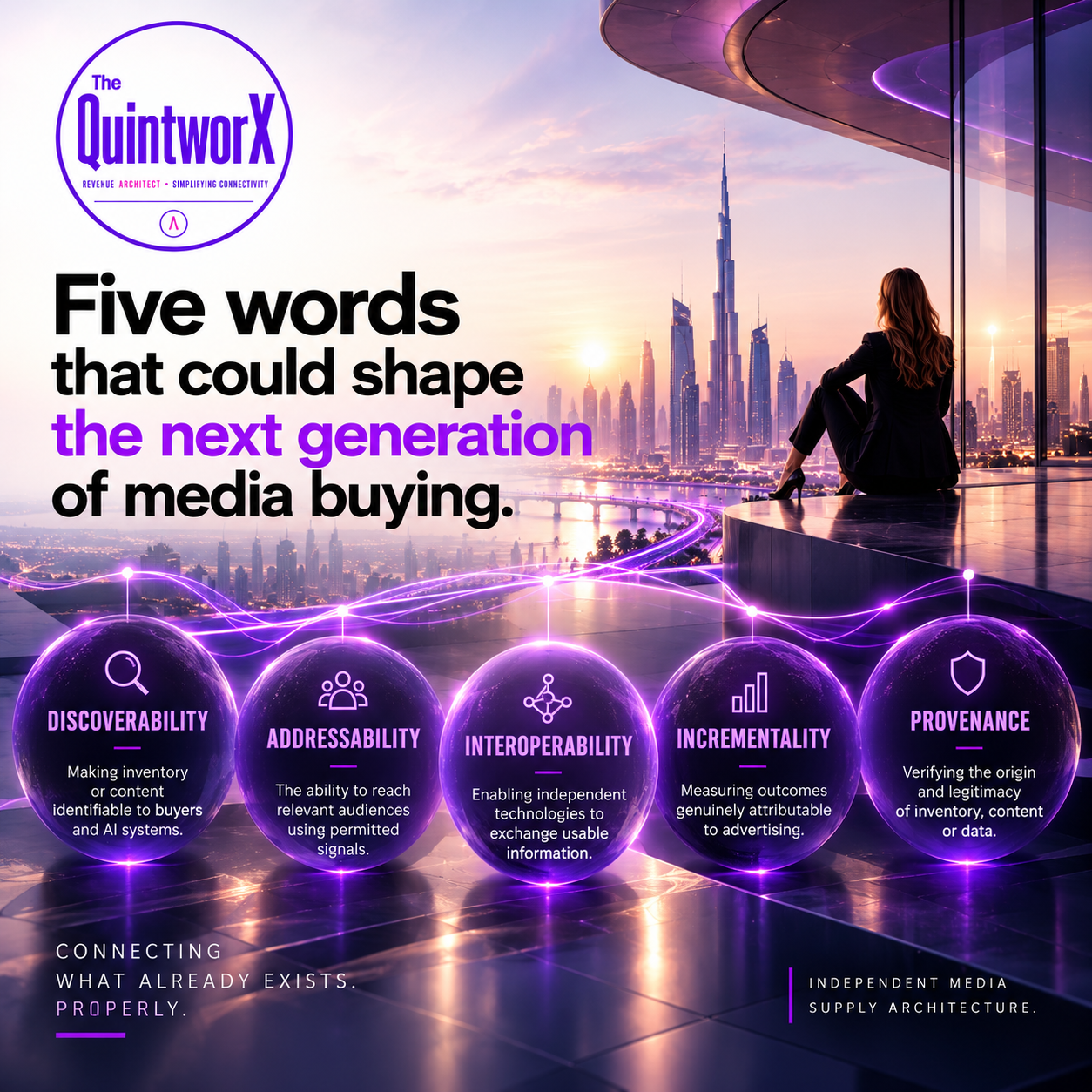
Five words that I believe will shape the next generation of media buying
Sophie Toth on the five fundamentals, discoverability, addressability, interoperability, incrementality and provenance, that must be right before AI, agentic buying and automation can deliver.
By Sophie Toth
Published
By Sophie Toth · QuintworX founder
Perspective disclaimer: This article presents QuintworX thoughts, opinions and predictions. It is not a statement of verified industry outcomes, a forecast or a guarantee of future developments.
Discoverability. Addressability. Interoperability. Incrementality. Provenance.
We talk a lot about AI, agentic buying and automation, but I believe we need to get these five fundamentals right first.
Discoverability
If buyers, including AI agents, cannot find and understand your inventory, how will they buy it?
But I think discoverability goes much further than that. Will every website eventually need a relatively clean user experience, with more emphasis on AI visibility and perhaps content usage fees? Could those fees help fill the revenue gap that content creators and publishers might face if traditional advertising and sponsored content revenues decline?
I’m not convinced they will fully replace that revenue.
I believe publishers that create experiences and encourage interaction will have better opportunities to monetise their on-site audiences. Giving people a reason to visit, participate and stay could become far more important than simply providing information that can be summarised elsewhere.
I can also see on-site and off-site monetisation developing in ways that resemble what we currently call syndication, but in a different form. Content may travel further, while the commercial value of the original environment becomes something publishers need to think about more carefully.
Addressability
It’s not about collecting more data. It’s about using the right signals, responsibly, to connect the right audiences with the right opportunities.
For me, making data actionable was always the first thought, the first brick in the wall.
If you’re sitting on enormous amounts of data but cannot turn it into relevant information, meaningful experiences or commercial value, what is the point?
And if this is the foundation of your business, I think now is the time to rethink your approach. Collecting more information will not necessarily make a shrinking business sustainable.
Interoperability
We don’t need every business using the same technology. We need independent systems that can actually communicate.
This is one of the strongest principles I believe in, and it’s also at the heart of QuintworX.
I believe publishers that are ready to choose simplicity over complexity, and maintain a degree of technological independence, could gain significant traction in the future.
I’m not saying large platforms will disappear overnight, but I do think the idea that one platform should control everything will be increasingly challenged.
Why shouldn’t independent technologies work together, connect with one another and deliver the best outcome for the business?
Perhaps we will reach a point where content and inventory are so well described and classified that the platform through which they are accessed becomes less important. Of course, trust will still need to be earned.
To me, independence doesn’t mean isolation. It means having choices and being able to make decisions based on what’s right for your business.
Incrementality
More impressions and higher revenue don’t automatically mean better results. We need to understand what genuinely created additional value.
This is another big one for me.
Most of the time, we tend to focus on what comes in, while what goes out becomes secondary.
We celebrate additional demand, more ad requests, new partners and higher revenue. But how often do we look at the full picture? What did it cost us? Did we improve the user experience? Did we actually generate additional value, or simply redistribute existing revenue?
This is also something I want QuintworX to support: meaningful comparisons and smarter decisions about what works best for a particular business.
There is a limit to available demand and advertiser budgets, even though the number of ad requests we can theoretically generate seems almost infinite.
More opportunities to serve an advertisement don’t automatically create more money in the market.
Sometimes the smartest decision isn’t to add something. It’s to understand what you already have and make it work better.
Provenance
Before we automate transactions at scale, we need to know who we’re dealing with, what we’re buying and whether we can trust it.
Perhaps this is the most challenging of all five.
We’re constantly trying to make sense of the unknown, and I have to say, sometimes it feels almost impossible.
What exists today might disappear tomorrow. A technology, a business relationship or even an entire way of operating can change faster than we can properly understand its implications.
Our world is changing at a pace that challenges our ability to comprehend everything and solve every problem through rational analysis alone.
And this is where I believe intellectually curious and intuitive people will become increasingly valuable in business.
People who question things, connect information, recognise patterns and sometimes sense that something isn’t quite right before the numbers reveal it.
Of course, intuition should never replace evidence. But I don’t believe evidence and intuition need to compete with one another.
As we automate more decisions, human judgement may become even more important.
Connectivity with competence
For me, these aren’t five separate industry buzzwords. They are connected parts of the same architecture.
And this is particularly important for traditional publishers and media owners. They may have fantastic content, audiences and commercial relationships, but if those assets aren’t accessible to the next generation of buying systems, they risk becoming invisible.
At the same time, I don’t believe everything needs to become automated. There will always be room for human relationships, direct commercial partnerships and experiences that cannot be reduced to a transaction.
We don’t need another platform. We need connectivity with competence.
Independent governance, actionable data and the right technology, creating connected micro-ecosystems around assets that already exist.
And perhaps most importantly, we need to walk slowly enough to understand what we’re doing. Check the evidence, question the assumptions and verify that everything works before scaling it.
I think we’ve spent years adding technology to solve problems, sometimes creating new problems in the process.
Maybe the next generation of media buying will require us to think a little differently.
The future isn’t necessarily about building more. It’s about connecting what we already have, properly.
And knowing why we’re connecting it in the first place.
QuintworX | Independent Media Supply Architecture
Next step
If this describes an asset base you already control, the next step is a diagnosis rather than a technology decision.